
Where to begin
Starting your family tree can lead you on a fascinating journey of discovery. Once you begin, you will soon realise that researching your family history is both exciting and highly rewarding. However, be warned — genealogy can quickly become an absorbing hobby and, for many people, something of an obsession.
If you are building your family tree for the first time, the amount of information available may initially seem overwhelming. The key is to keep things simple and focus on researching one branch of the family at a time.
For example, I began by concentrating on my father’s side of the family, as I already had some information provided by another relative. To start with, I recorded only the basic details such as names, dates and locations. Whenever I reached a point where progress became difficult, I returned to earlier generations to add further detail and context. Along the way, my own research uncovered connections to a renowned 19th-century scientist and a 17th-century mayor, making the experience even more rewarding.
By carefully recording names, dates, places and family relationships, you can gradually create a rich and detailed history of your family — one that can be preserved and enjoyed by future generations.
The essential details to record are:
- Full Name (and maiden names)
- Date and place of birth
- Name of parents.
- Date and place of marriage/s.
- Name and previous name/s of spouse.
- Date of death
- Date and place of burial.
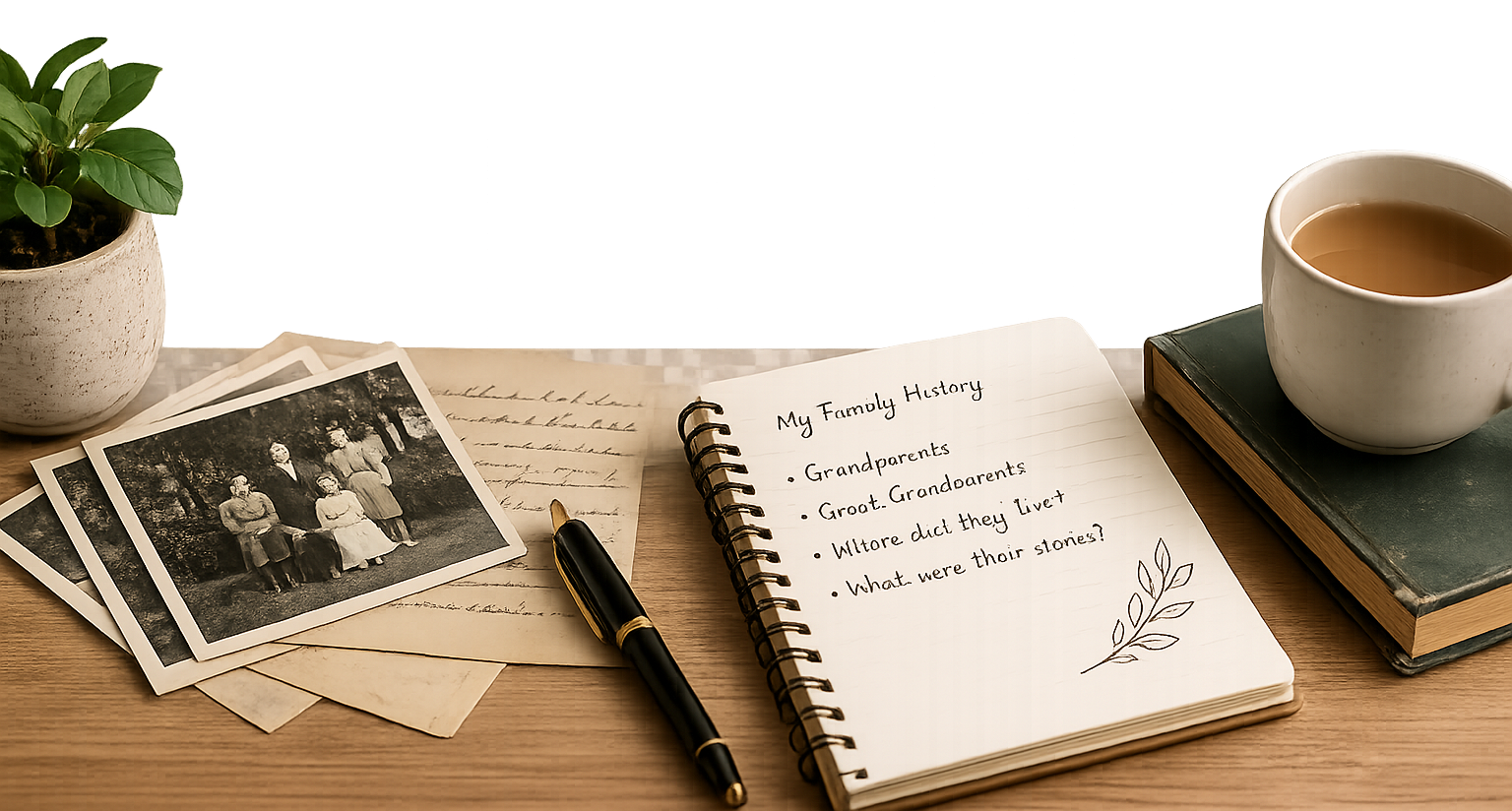
Try to record as many of these as possible. I would suggest recording these in a looseleaf notebook. It is best to keep one page per ancestor and reference each person’s position on the family tree.
Start with the basics and start with the family you know. Begin with your parents, grandparents, uncles and aunts. They may already have information about your family which you are unaware of. Some might even have been researching their family tree.
Free sources of information
Existing Family Records
You may be fortunate, as I was, to inherit an existing family tree from another family member. While this can provide an excellent starting point, it can also present certain challenges. Early family records are sometimes based on family stories, misunderstandings or assumptions that have been passed down through generations.
For this reason, it is always important to verify information wherever possible and seek supporting evidence from reliable sources such as official records, census returns and parish registers. This is an area where I can certainly speak from experience, having discovered that not every long-held family story proved to be entirely accurate.
Parish Records
FreeREG provides access to transcriptions of baptism, marriage and burial records from the Church of England and other religious organisations. Parish registers began to be recorded in England and Wales in 1538, making them an invaluable resource for tracing family history before the introduction of civil registration.
These records are entirely separate from the system of civil registration that began in 1837 and can often help researchers trace family lines back several centuries.
Births, Deaths & Marriages
FreeBMD offers free access to birth, marriage and death index records for England and Wales. It is an excellent starting point for anyone beginning research into their family history.
Civil registration of births, marriages and deaths began in 1837 and remains one of the most important resources available to genealogists. The FreeBMD database is maintained by a dedicated team of volunteers and currently includes transcribed index information covering the years 1837 to 1996.
Census Records
FreeCEN provides free online access to transcriptions of 19th-century UK census returns. Census records are particularly valuable because they can reveal detailed information about individuals and households, including:
- Full names
- Exact ages
- Relationships within the household
- Occupations
- Parish and county of birth
- Employment status
- Medical disabilities recorded at the time
As census records progressed through the 19th century, the amount of information collected became increasingly detailed. FreeCEN continues to expand its database and currently includes work on the 1841, 1851, 1861, 1871 and 1891 censuses, with some counties also transcribing the 1881 census.
Other Sources
There are other sources of information some of which are free and some which are charged, usually by subscription.
Other free sources include:
- UK General Registry Office
- 1939 Register
- FamilySearch.org